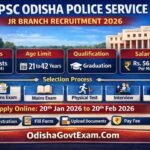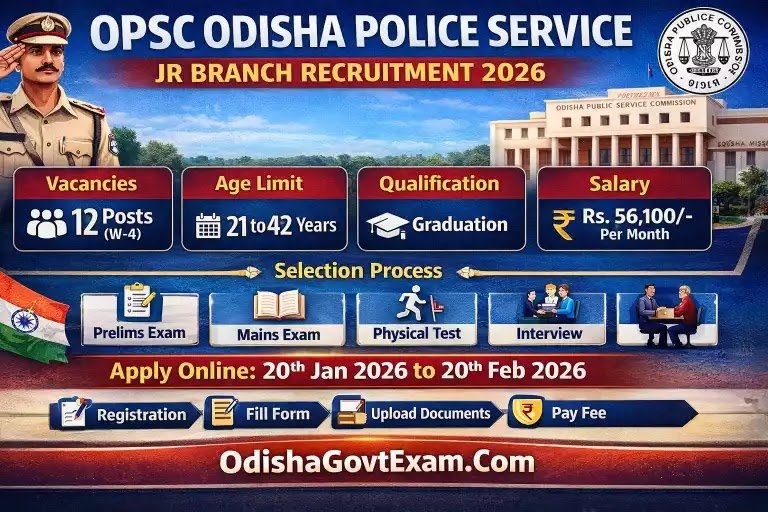
The Odisha Police Service (Junior Branch), or OPS Junior Branch, is a prestigious Group A post in Odisha’s state civil services. OPS officers play a vital role in maintaining law and order. They investigate crimes, prevent violence, and protect citizens. In Odisha, where issues like Naxalism, cyclones, and urban crime exist, OPS officers are essential. They work closely with the Indian Police Service (IPS) but focus on state-level duties. The Odisha Public Service Commission (OPSC) recruits through the Odisha Civil Services (OCS) exam. In the latest OPSC OCS 2026 notification, there are 12 vacancies for OPS Junior Branch (including 4 reserved for women). This is part of 465 total vacancies across Group A and B posts. The application closed on February 20, 2026, but this guide helps future aspirants. Many young graduates in Odisha aim for this job. It offers respect, adventure, good salary, and a chance to serve the community.
OPS has a rich history. It began after India’s independence in the 1950s. Before that, police worked under British rules. Odisha created its own service to handle local needs. Over decades, OPS evolved. It now uses modern tools like CCTV, forensic labs, and cyber units. Women officers have increased. They handle cases like domestic violence and trafficking better. In Odisha, OPS focuses on tribal areas, coastal security, and community policing. Reforms make police more approachable. Officers now use apps for complaints. This job is challenging but rewarding. You make a real difference in people’s lives.
Eligibility Criteria for OPS Junior Branch
To apply, follow strict rules. Education comes first. You need a bachelor’s degree from any recognized university. Any stream works – Arts, Science, Commerce, or Engineering.
Age limit is 21 to 38 years (as on the cutoff date in the notification, usually January 1 of the exam year). Relaxations apply. SC/ST get 5 years extra. SEBC also gets 5 years. Women get 5 years. PwBD get 10 years. Ex-servicemen have separate rules.
Odia language knowledge is mandatory. You must read, write, and speak it. Proof is passing Odia as a subject in Class 8 or higher, or studying in Odia medium.
You must be an Indian citizen. Good character and no criminal record are required. A medical test checks fitness.
For OPS, physical standards are important (different from other services). For men:
- Height: 165 cm (UR/SEBC/SC), 160 cm (ST)
- Chest: 84 cm unexpanded to 89 cm expanded (UR/SEBC/SC), 79 cm to 84 cm (ST)
- Weight: Around 55 kg (UR/SEBC/SC), 50 kg (ST)
For women:
- Height: 155 cm (UR/SEBC/SC), 150 cm (ST)
- Weight: Around 47.5 kg (UR/SEBC/SC), 45 kg (ST)
Vision must be good (6/6 without glasses for distant vision). No color blindness. Physical measurement happens after mains for qualifying candidates. Fail means disqualification. These standards come from Home Department and OPSC rules.
The Recruitment Process: OPSC OCS Exam
OPSC conducts the OCS exam for multiple services, including OPS. The 2026 notification (Advt No. 05 of 2025-26) came in January 2026. It covers prelims, mains, interview, and physical test for OPS.
Stage 1: Preliminary Exam
Two objective papers (MCQ).
- Paper 1: General Studies – 200 marks, 2 hours
- Paper 2: CSAT (qualifying) – 200 marks, 2 hours (need 33%)
Negative marking: 1/3 for wrong answers.
Stage 2: Mains Exam
Nine papers total. Two qualifying (Odia and English, 250 marks each). Seven merit papers:
- Essay: 250 marks
- GS Paper 1: 250 marks
- GS Paper 2: 250 marks
- GS Paper 3: 250 marks
- GS Paper 4 (Ethics): 250 marks
- Two Optional subjects: 500 marks total
Each paper 3 hours. Total merit: 1750 marks.
Stage 3: Personality Test (Interview)
250 marks. It checks personality, knowledge, and suitability for police role.
Stage 4: Physical Measurement Test (for OPS qualifiers)
After mains. Includes height, chest, weight check.
Final merit combines mains and interview (2000 marks). Physical is qualifying.
Also Read Odisha Administrative Service (OAS): Your Path to a Prestigious Government Career
Detailed Syllabus for OPSC OCS
Prelims
Paper 1 (GS): Current affairs, Indian history, geography, polity, economy, environment, science, aptitude.
Paper 2 (CSAT): Comprehension, reasoning, decision-making, numeracy (Class 10 level), data interpretation.
Mains
Qualifying: Odia/English – comprehension, essay, grammar, translation.
Merit Papers:
- Essay: National/current issues
- GS1: History, culture, geography, disasters
- GS2: Polity, governance, social justice, international relations
- GS3: Economy, agriculture, technology, environment, internal security (key for OPS)
- GS4: Ethics, integrity, aptitude
- Optionals: Choose two (e.g., Law, Sociology, Public Administration suit police roles)
Syllabus is vast but standard. Focus on security topics for OPS.
Preparation Tips for OPS Aspirants
Start early with a study plan. Read newspapers daily – The Hindu for national, Sambad/Dharitri for Odisha. Use books like:
- Polity: M. Laxmikanth
- History: NCERT/Bipan Chandra
- Economy: Ramesh Singh
- GS3: Focus on internal security books
Practice mocks and previous papers. Join coaching in Bhubaneswar (e.g., APTI Plus). Study 8-10 hours daily. For physical, train running, gym, yoga. Know Odisha issues – Naxalism, trafficking, cyber crime. For interview, be confident and honest.
Salary and Perks
OPS Junior Branch starts at Level 12, Cell-1. Basic pay: Rs 56,100 (under ORSP Rules 2017). Pay scale: Rs 56,100 – Rs 1,77,500.
In-hand salary: Around Rs 60,000–70,000 monthly (with DA ~50%, HRA 8-27%, transport allowance).
Perks include government accommodation, official vehicle, medical benefits for family, leave travel, pension. During 2-year training, full pay.
Training for OPS Officers
Selected candidates train at Biju Patnaik State Police Academy (BPSPA), Bhubaneswar. It lasts about 2 years. Training includes classroom sessions on law, investigation, forensics, and physical drills. Field training teaches practical skills like arms handling and crowd control. The academy focuses on professionalism and values.
Career Progression and Roles
Start as Deputy Superintendent of Police (DSP) or equivalent in Junior Branch. After 6–10 years, promote to Senior Branch (Additional SP, SP). Higher levels: DIG, IG, DGP possible. Promotions based on service, performance, and exams. Some get IPS promotion later.
Roles: Lead police stations, investigate cases, maintain peace, handle VIP security, manage disasters, fight Naxals/trafficking. Community policing and cyber units are growing. High responsibility but exciting.
Why Choose OPS Junior Branch? Challenges and Rewards
OPS offers adventure, power, and service. Job security, good pay, respect. Help people directly.
Challenges: Danger, long hours, transfers, stress. Rural postings tough. Family life affected. But training builds resilience. Many find it fulfilling.
If you want action and public service in Odisha, OPS is ideal. Prepare hard – success changes lives.
FAQs
What is OPS Junior Branch?
It is the entry-level Group A post in Odisha Police Service for civil administration roles in policing.
How many vacancies for OPS in OCS 2026?
12 vacancies (4 for women).
What is the age limit?
21 to 38 years, with relaxations for reserved categories.
What are the physical standards for men?
Height 165 cm (UR/SEBC/SC), chest 84-89 cm, weight around 55 kg.
What is the starting salary?
Basic pay Rs 56,100 (Level 12). In-hand Rs 60,000+ with allowances.
What are the exam stages?
Prelims, Mains, Interview, and Physical Measurement Test.
Where is the training conducted?
Biju Patnaik State Police Academy, Bhubaneswar (2 years).
Can OPS officers get promoted to IPS?
Yes, after years of service through selection and promotion process.
This guide is based on the latest OPSC OCS 2026 details. Check opsc.gov.in for official updates. Good luck to all aspirants!